top of page
Hi, I'm Noah
Future-Proofing Berkeley Amtrak
Over the summer of 2024, I worked with BART and Amtrak Capitol Corridor on the Link21 mega project. The specific project that me and my team were working on was future-proofing the Berkeley Amtrak station.
We had a couple main goals with this project, firstly, we wanted to improve connection between the station and the surrounding environment located immediately around the station. Secondly, we sought to improve connections between the station and the rest of the city, such as linking the station to destinations such as Downtown and the University. Lastly, we wanted to increase the capacity and safety of the station to transform to meet modern standards.
Let's start with focusing on the connection with the immediate surroundings. A train station should be the center of a community, it should feel open and visible, somewhere that is easy to access and recognize. Unfortunately, the Berkeley Amtrak station does not fit that definition. Despite being surrounded by the vibrant 4th street district and numerous large biotech firms, the station is disconnected. Tucked behind parking lots and apartment buildings, it is practically impossible to see from anywhere. And this is not just speculation, I personally have had people ask me how to get to 4th street from the station or from the station to fourth street. This station is located in a busy area, however because of the disconnection between the station and the neighborhood, many shoppers are unaware that there is even a
station there at all.
View of the 4th street shops from the station
The most simple fix to improve access to the station is though signage. This could take many forms, such as traditional wayfinding signs that point people towards destinations in the area, such as the Amtrak station. It could also include innovative forms such as smart screens located on streets in the area that could display, amongst other things, train arrivals.
Example of a information display, other examples could include IKE displays present in Berkeley
The Berkeley Amtrak station is located in West Berkeley, however most people want to go to downtown and the University. This requires a convenient link between the station and other destinations.
We considered many possible solutions, but in the end there were only a couple that made sense. The first option is a light rail line that would run up University Avenue, terminating at the Crescent Lawn at UC Berkeley. I have dedicated an entire page to this, so if you are interested in looking in depth into this, you can check it out here. Essentially, a light rail line would be the most attractive option, however it would also be the most expensive.
Another option would be to construct dedicated bus lanes along University Avenue. There are two ways this could work. The first option is simply to paint bus lanes along the curb of University, as well as Transit Signal Priority, allowing busses to catch green lights. Another way this could be implemented is to build a proper Bus Rapid Transit line with dedicated, fast charging electric busses that would serve the corridor.
Van Ness Bus Rapid Transit in San Francisco, example of complete BRT
The last thing that needs to be improved upon with the station is to bring it up to modern safety standards and increase potential capacity. The current design of the station is known as a hold out station, this means that there is one side platform for two tracks. This means that only one train can board passengers at the station at one time, requiring the other train to 'hold out' of the station, giving the station its name. This station design is inefficient and unsafe, as it requires some passengers to stand on active tracks in order to board their train.
A train boarding on the far track, requiring passengers to cross active tracks to board
This can be a problem even with current service frequencies of roughly one train per hour per direction, so just imagine what it would look like with increased frequencies in the future. Simply put, the current station design would not be able to accommodate such levels of service.
The most simple fix for this problem would be to create a second platform to serve the other track. This would make the station vastly safer, more efficient, and easier to use, accommodating more people who would be interested in trying the train.
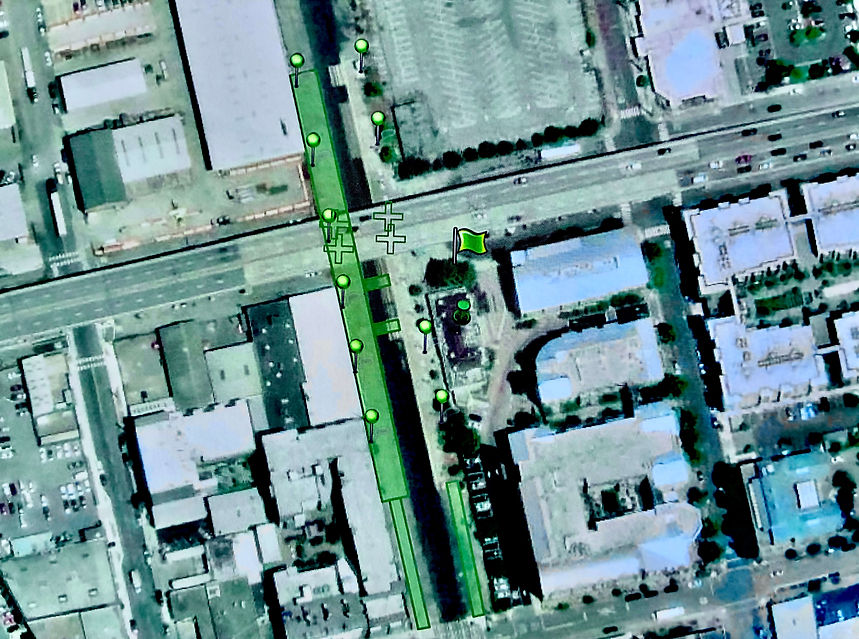
Diagram showing second platform and paths leading to Addison Street
The most complicated part of having another platform is getting people across the tracks to the other platform. There are three ways you could do this. You could build an underpass, an at grade crossing, or an overpass.
The best option would be a combination of two at grade crossings at 1/3 and 2/3 of the way down the platform, as well as an overpass in the middle. The reason that this is the best option is that at grade crossings are the most convenient option for people, instead of requiring people to go up and over the tracks, they could just walk the flat, 20 feet. However, these crossings do have their flaws. Having people interact with an active right of way is inherently dangerous, additionally, these crossings would become blocked when a train is in the station or arriving. This is where elevated crossings come in. Elevated crossings don't require people to directly interact with the tracks making them far safer, additionally, they are far less expensive to build and more attractive that an underground tunnel. It might seem reasonable to only install a overpass then. While it might seem that would be safer, you have to consider how people are actually going to interact with the space. Most people will use the overpass to cross the tracks, however some people simply walk across the tracks. This is far more risky that having people cross the tracks at an at grade crossing, as these people would be crossing without any warning devices there to keep them safe. Most people who cross this way will be perfectly fine, however it is still a dangerous setup, even if a fence is installed between the tracks to keep people from crossing.
This station has the capability to be a popular and convenient station that connects Berkeley to the rest of the region, and these upgrades, coupled with increased train service can help this station reach its potential.


bottom of page